
Government should focus on capital expenditure

'Government should focus on capital expenditure' Former Vice Chairman of NITI Aayog Rajiv Kumar has said that the Center should focus on capital expenditure to bridge the country's infrastructure gap.
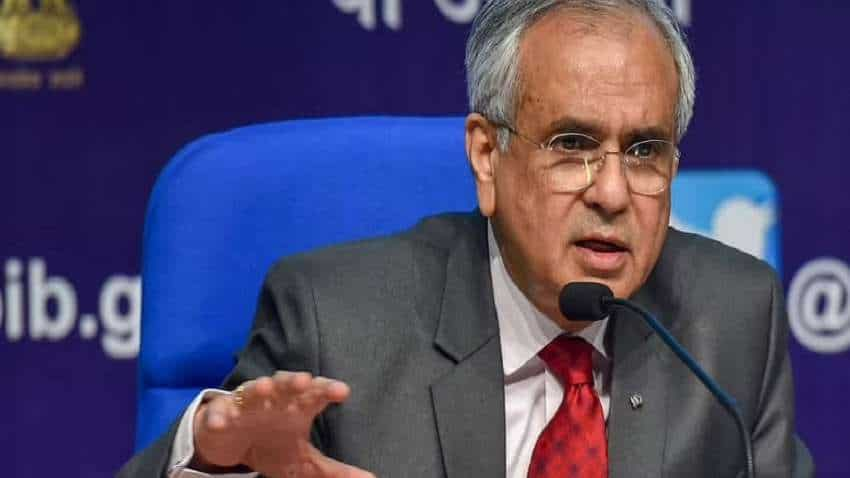
Government should focus on capital expenditure
NITI Aayog Rajiv Kumar

He also said

And since private investment remains weak, government capital expenditure is crucial, he said.

The central government should continue to undertake capital enrichment to bridge the infrastructure gap that has plagued the Indian economy. Rajiv Kumar said that more attention should be given to capital expenditure in the interim budget to be presented.

The government is able to maintain fiscal consolidation due to the small improvement in the ratio between tax and GDP despite increasing capital expenditure. Also the broadening of indirect tax revenue and direct tax revenue base will also help. He said this.

Fiscal deficit reached 55 percent of the budget target.


At the end of December last year, the central government has announced that the country's financial deficit has reached 55 percent of the budget target.

The central government has estimated that the fiscal deficit for the current financial year will be 5.90 percent of the GDP or 17.86 lakh crore rupees.

In this case, the financial deficit has reached 9.82 lakh crore rupees at the end of last December.

Similarly, the net tax revenue for the period up to the end of December was 17.29 lakh crore rupees. This is 74.20 percent of Budjet's target.

The total expenditure of the government during the period from April to December was 30.54 lakh crore rupees. This is 67.80 percent of the budget target.

It is noteworthy that the government has decided to bring the fiscal deficit below 4.50 percent of the GDP in the coming financial year as part of fiscal consolidation.


Comments

Popular posts from this blog

At one time, the tax rate in India was 97.50

Many feel that foreign countries tax the rich very heavily and India does not. But did you know that at one time India had to pay 97.50 percent of income tax? Indira Gandhi What is the historical tax rate in India Debates such as distribution of wealth and introduction of inheritance tax have arisen and are currently being discussed in a frenzy. But, in our country, 50 years ago, maximum tax was collected up to 97.50 percent. There was such a period in India. During Indira Gandhi's tenure as Prime Minister, income tax in India was as high as 97.50 percent. However, this collection came to an end shortly after. Indira Gandhi saw taxation as an important mechanism to balance income and wealth. Based on this, in February 1970, he presented the budget in Parliament and addressed it. Social welfare was the theme of the budget. Since the green revolution was taking place, various announcements related to the agriculture sector were included in the budget. A huge sum...

Emmvee Photovoltaic Power Share Price Target 2030: Is It a Buy?

The renewable energy sector, particularly the solar energy segment, is growing rapidly. If you are looking for long-term growth opportunities in this sector, 'Emmvee Photovoltaic Power' is a company that warrants your attention. Based on recent market studies and financial reports, we outline the company's key operational metrics here and analyze why market analysts recommend it as an excellent long-term investment. Emmvee Photovoltaic Power: Key Stock and Market Metrics As of July 16, 2026, the company’s stock boasts strong fundamentals, supported by robust operating profit margins and excellent capital utilization. Metric | Details / Statistics Current Share Price (as of 16.07.2026): ₹365.35 Market Capitalization: ₹24,696 Crore Analyst Recommendation: Buy Recommended Investment Horizon: 5 years Expected Target Price (by 2030): ₹628.00 A Detailed Look at Financial and Valuation Ratios To understand why analysts are confident that Emmvee Photovoltaic Power will reach a targ...

What is the future prediction of Vedanta share in 2026?

To enable investors to choose sectors that align with their preferences, the Vedanta Group has demerged into four separate entities, which were listed on the stock exchange the day before yesterday.  What is the outlook for the four newly listed Vedanta entities over the next six months? Stock market expert Reji Thomas shares his insights regarding their performance and the outlook for the next 3–6 months. Vedanta Aluminium Metal Price: 471 Operations: India’s leading integrated aluminium producer, covering the entire value chain—from bauxite mining and refining to the manufacture of products for sectors such as construction, automotive, power, and packaging. Business Outlook: Driven by large-scale infrastructure, low production costs, and steady demand, this is considered the strongest business among Vedanta's four new entities. Next 3–6 Months: Revenue and market valuation are expected to rise in the coming quarters, supported by international price stability and strong domesti...